

Supporting Your Child with Revision: The Power of Flash Cards
Flash cards are a simple yet highly effective tool for helping students
retain and recall information —
and parents can play a big role in
supporting their use at home.
Why Flash Cards Work
Flash cards are small cards with a question on one side and the
answer on the other. They help students:
• Break down complex topics into bite-sized facts or
questions.
• Actively recall information, which strengthens memory.
• Self-test regularly,
identifying gaps in knowledge.
• Use spaced repetition, revisiting cards over time to boost long-term
retention.
This method is backed by research and is especially useful for subjects that require factual
recall, such as
science, history, and languages.
Why Are They Effective?
Flash cards encourage active learning — students test themselves rather than just re-reading notes.
This
helps them remember more and feel more confident when it comes to assessments.
They also
support spaced repetition, which means reviewing information over time rather than cramming.
This
technique is backed by research and helps knowledge stick.
How Parents Can Help
You don’t need to be an expert in the subject to support your
child’s revision. Here are some easy ways to
get involved:
• Quiz your child using their flash cards
— even just 10 minutes a day can make a difference.
• Encourage them to sort cards into “confident” and
“needs more practice” piles.
• Help them set up a revision routine, using flash cards regularly rather
than cramming.
• Ask them to teach you a topic using their cards — explaining concepts aloud helps
deepen
understanding.
• Praise their effort and consistency, not just correct
answers.
Top Tip
If your child prefers digital tools, apps like Anki, Quizlet, or
Brainscape allow them to create and review flash
cards on their phone or computer — perfect for revision
on the go.
Resources for Further Exploration
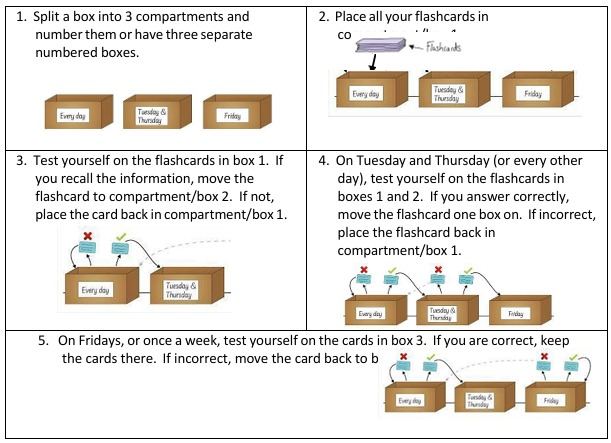
The Leitner Method – what it is and how it
helps
The Leitner Method is a way of quizzing with flashcards where students move the cards to
different
compartments depending on whether or not they recalled the information correctly. This
strategy makes use of retrieval and spacing.
 Useful links
• Birmingham City University – How to Use Flashcards for
Revision
Covers active recall, spaced repetition, Leitner system, visuals, and app options like Quizlet
and Anki
(Birmingham
City University).
• SchoolPlanner – Revision Flashcards Blog
Emphasizes peer feedback, visual
memory, concise content, and hands-on repetition (schoolplanner.co.uk).
•
Learning Scientists – “Be Your Own Teacher: How to Study with Flashcards”
Offers dual-stack method
(concept + instruction cards) to deepen understanding (The Learning
Scientists).
• InnerDrive – Flashcards Retrieval Practice Overview
Highlights how flashcards
support self-testing and focus on weak areas (InnerDrive).
•
Wikipedia – Spaced Repetition, Testing Effect, Leitner System
In-depth background on flashcards'
cognitive science foundations (Wikipedia).
Mind maps
 Why Mind maps Are great for
revision
Why Mind maps Are great for
revision
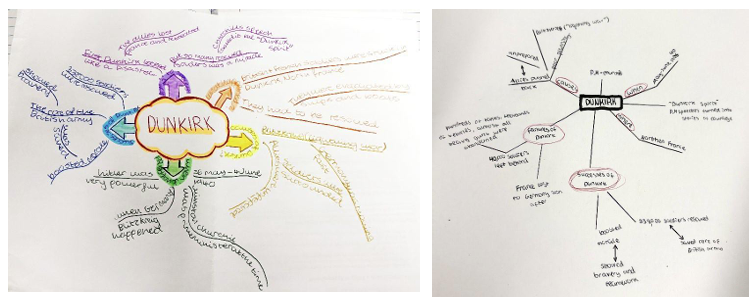
Mind maps are a simple but powerful way for students to organise information
visually. Instead of writing long notes, a mind map uses keywords, colours, and branches to show how ideas
connect. This helps students:
• See the bigger picture – They can understand how topics link
together.
• Boost memory – Using colours and images makes information easier to recall.
• Stay
engaged – It feels more creative and less overwhelming than pages of text.
• Focus on key points – Mind
maps encourage summarising, which is essential for exams.
 How parents can
support
How parents can
support
You don’t need to know the subject in detail! Here’s what you can do:
1. Provide
materials – Paper, coloured pens.
2. Ask guiding questions – “What’s the main topic?” or “What ideas
link to this?”
3. Check for clarity – Encourage your child to use short keywords, not full sentences.
4. Celebrate
effort – Praise the creativity and organisation, not just the neatness.
5. Use it for discussion – Ask
them to explain their mind map to you. Teaching someone else reinforces learning.
Draw, discuss, review, review, review ….
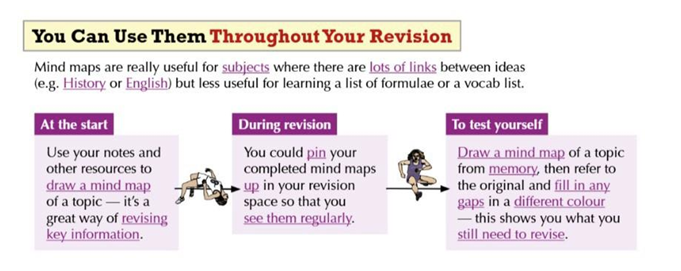
Drawing out the mind map is just the first
stage. Discuss your mind map with someone. Then review it. Cover up your original mind map, and re-draw it
on a new piece of paper. See what you can remember. If you are struggling, take a sneaky peak to remind you.
Do this again a week later, a month later. Every time you review a mind map, leave a roman numeral, (I,II,
III, IV). That way you have a general idea of how many times you’ve revisited the information.
Useful links
Revision
techniques from BBC Bitesize
Save My Exams – Revision Mind Maps: Your Key to Exam
Success
Explains what mind maps are, why they work, and step-by-step tips for creating effective
ones.
Read the guide here [savemyexams.com]
Mind
Map Online – 3 Ways to Use Mind Mapping for Better Revision
Practical strategies for using mind maps to
improve memory and organisation.
Explore the tips [mind-map.com]
Student
Beans – Using Mind Maps for Revision: The Ultimate Guide
Covers benefits, examples, and how to create
mind maps effectively.
Read the full guide [studentbeans.com]
The Power of Blurting
What is blurting?
Blurting (also known as a brain dump), is a quick-fire revision
technique where a student:
1. Reads or revises a topic (from a textbook, class notes,
or a knowledge organiser) for 5 minutes
2. Closes the book
3. Writes down
everything they can remember — without looking
4. Checks what they missed
and adds it in using a different coloured pen to fill gaps or correct errors
5. Repeats the
process later to see what has stuck
It’s low-pressure, highly effective, and works for every
subject.
Why does Blurting work?
Blurting strengthens learning because it:
✔ Boosts
memory through retrieval practice
Rather than re-reading notes (which often feels productive
but doesn’t always lead to long-term learning), blurting forces the brain to actively retrieve
information.
This strengthens memory pathways and makes recall easier during exams.
✔
Highlights gaps clearly
When students compare their “blurt” to the original notes, they can
instantly see what they’ve remembered well — and what needs more work.
✔ Builds
confidence
Seeing how much they can recall helps reduce exam anxiety and makes revision feel
purposeful.
How parents can help
You don’t need to be an expert in the subject.
Here are simple ways to help:
• Provide a
quiet space and a regular revision slot
• Encourage short, focused sessions
(15–20 mins at a time)
• Ask simple prompts, such as:
o “Show me what you can
remember about that topic.”
o “What did you miss when you checked?”
o “What’s improved since last
time?”
• Celebrate effort, not just the result
• Praise
persistence — blurting gets easier with practice.
Top Tips
• Blurting is most effective in short bursts over time, not
cramming
• Encourage your child to date each blurt so they can see progress
• If
they get stuck, they can say their blurt aloud before writing
• Completing a blurt on
rough paper removes pressure to be perfect
Useful links:
How to revise
with the blurting method - Exams and Revision | Birmingham City University
Blurting Revision
Technique | Beyond - Twinkl
Look, say, cover, write, check
What is Look, say, cover, write, check?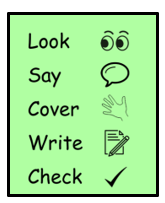
The Look, say, cover, write, check is a structured revision strategy which students can use across subjects. This method supports accurate recall and is particularly useful for learning spellings, quotes and subject‑specific terminology.
Your child will:
- Look closely at the word, phrase or information
- Say it aloud
- Cover it up
- Write it from memory
- Check and correct any mistakes
Why does Look, say, cover, write, check work?
- This strategy combines visual, verbal and written learning, helping students remember information more effectively. Combining seeing, saying and writing helps to strengthen memory.
- It is especially helpful in subjects where accurate spelling of key terms is essential. Repeating this process helps information stick.
- It is a quick and structured method and can be used to revise information across all subjects.
- For deeper revision, students are encouraged to use the strategy after creating a mind map or flash cards, helping them secure important information once they understand the topic.
How parents can help
- Ask your child to say words/information aloud
- Check spellings, definitions and understanding together
- Encourage short, regular revision sessions
- Ask: ‘What does that word mean’? or ‘Can you use it in a sentence’?
- Prompt your child to reflect – what could they remember, what do they still need to focus on?
Top Tips
- Best used after your child understands the topic
- Especially helpful for key terminology, subject keywords and spellings
- Little and often practice works better than long revision sessions
- Focus on accuracy, not rushing
- Works best alongside other strategies like mind maps, flash cards or practice questions